| The Burmite Team |
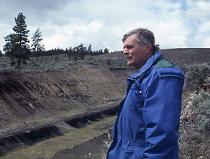
Jim Davis
B.S. M.S. Geology
jdavis@taiga-ltd.com
Biography
Jim Davis is a graduate of St. Louis University with both a Bachelor (1967) and a Masters Degree (1969) in Geology. He
is a professional geologist and a Fellow of the Geological Association of Canada. After graduation he worked for
Geophoto Services, a division of Texas Instruments, completing air photo and satellite interpretations and field
exploration for both petroleum and mining company clients. This included exploration in the Yukon and Northwest
Territories.
In 1973, he joined Union Oil of Canada as a petroleum geologist and later started a minerals exploration group at Union
Oil. In addition to field structural mapping in the Northwest Territories for oil and gas, he carried out exploration for coal
in Alberta and uranium Saskatchewan and in what is now Nunavut Territory .
He joined Taiga consultants Ltd. In 1978 and is vice president of that organization. Projects carried out included
exploration for uranium, gold, platinum, base metals and diamonds. His work as an exploration geologist has taken him
to remote areas of Canada , Southeast Asia and Africa.
In addition to being a consulting geologist with Taiga Consultants, he became the president of Leeward Capital Corp. in
1988. Leeward has explored for diamonds, gold and base metals in Canada and Southeast Asia. In 1996 Leeward
became involved in two concessions in Myanmar, one for base metals in the western part of the country and for platinum
and gold in Kachin State in northern Myanmar.
During the exploration in Kachin State, he became aware of the existence of amber deposits in the region. Upon
researching these occurrences, he sent an expedition to exploration to evaluate the commercial potential of such
deposits. In 1999, after establishing a working relationship with the Kachin people and the local Government, he initiated
the mining of amber through a local mining company and exporting the amber to Canada. Burmese amber or burmite is
the most highly prized Asian amber due to its age and high quality for jewellery. Evaluation of this amber has lead to the
discovery of many unique inclusions in this amber including both animal and plant fossils.
Presently, Leeward remains the sole exporter of burmite. Leeward is also is focused on developing a molybdenite mine
in Canada and a gold property in Nunavut. Jim is very pleased that through his efforts, he has brought burmite to the
attention of the scientific community, which has lead to the publication of more than twenty papers by various authors.
This research has opened new vistas on the development of life 100,000,000 years ago in the age of the dinosaurs.
B.S. M.S. Geology
jdavis@taiga-ltd.com
Biography
Jim Davis is a graduate of St. Louis University with both a Bachelor (1967) and a Masters Degree (1969) in Geology. He
is a professional geologist and a Fellow of the Geological Association of Canada. After graduation he worked for
Geophoto Services, a division of Texas Instruments, completing air photo and satellite interpretations and field
exploration for both petroleum and mining company clients. This included exploration in the Yukon and Northwest
Territories.
In 1973, he joined Union Oil of Canada as a petroleum geologist and later started a minerals exploration group at Union
Oil. In addition to field structural mapping in the Northwest Territories for oil and gas, he carried out exploration for coal
in Alberta and uranium Saskatchewan and in what is now Nunavut Territory .
He joined Taiga consultants Ltd. In 1978 and is vice president of that organization. Projects carried out included
exploration for uranium, gold, platinum, base metals and diamonds. His work as an exploration geologist has taken him
to remote areas of Canada , Southeast Asia and Africa.
In addition to being a consulting geologist with Taiga Consultants, he became the president of Leeward Capital Corp. in
1988. Leeward has explored for diamonds, gold and base metals in Canada and Southeast Asia. In 1996 Leeward
became involved in two concessions in Myanmar, one for base metals in the western part of the country and for platinum
and gold in Kachin State in northern Myanmar.
During the exploration in Kachin State, he became aware of the existence of amber deposits in the region. Upon
researching these occurrences, he sent an expedition to exploration to evaluate the commercial potential of such
deposits. In 1999, after establishing a working relationship with the Kachin people and the local Government, he initiated
the mining of amber through a local mining company and exporting the amber to Canada. Burmese amber or burmite is
the most highly prized Asian amber due to its age and high quality for jewellery. Evaluation of this amber has lead to the
discovery of many unique inclusions in this amber including both animal and plant fossils.
Presently, Leeward remains the sole exporter of burmite. Leeward is also is focused on developing a molybdenite mine
in Canada and a gold property in Nunavut. Jim is very pleased that through his efforts, he has brought burmite to the
attention of the scientific community, which has lead to the publication of more than twenty papers by various authors.
This research has opened new vistas on the development of life 100,000,000 years ago in the age of the dinosaurs.
How Jim Davis opened up the Burmite amber mining.
Leeward was exploring for platinum and gold in Kachin State in the northern part of the Union of Myanmar. Our
geological crew consisted of Doug Cruickshank, U Ko Ko and geologists from the Department of Geological Survey and
Mineral Exploration (DGSE). While unsuccessful in locating commercial deposits of these precious metals, one on the
DGSE geologist who worked for us presented an amber ring to Doug at the end of the program in 1999. When Doug
returned to Calgary he showed me the ring and asked if we could locate the source of the amber and go into the amber
business. I told him that we had $10,000 left in our account in Myanmar and that he and U Ko Ko should research amber
occurrences and travel to Kachin State to investigate.
My interest in investigating the possibility of producing a new gemstone in a country famous for its gems fascinated me.
The country was the home of the best jade, rubies, and sapphires along with semi precious gems such as peridote,
garnet and spinal. Subsequent research found references to Burmese amber being mined prior to the Second World
War. The amber was reported as possible Cretaceous to Eocene in age (100 million to 50 million years old). The reason
amber mining had not resumed after the war was that there was a local insurgency of the Kachin People against the
central government. Peace was not restored in the region until 1990 when an agreement between the government and
the insurgences was reached. Under the terms of this agreement, the government the Kachin Independence Army (KIA)
maintained control over part of the region including the area where the amber mines was thought to be located.
In 2000, Doug Cruickshank traveled to Myitkyina to determine whether there were local supplies of amber available.
They returned with 20 kg of amber purchased there and made contact with a local Kachin company that said they could
mine amber for Leeward. This amber was brought back to Calgary for evaluation. Not being familiar with the marketing
of amber I began the evaluation. One of the first things I did was to inspect the amber under a microscope to determine
whether it contained insect inclusions and indeed they were found to be present. The second phase of this evaluation
was to determine the quality and marketability of the amber. I found that although it was of high quality, the amber
market was flooded with Baltic amber and this new source of gem quality amber would not fetch a price to justify the
expense of mining it. As a result, I concentrated on the possibility of selling the insect inclusions.
In order to determine the value and exact age of the amber, I contacted Dr. David Grimaldi, a world renowned
paleo-entomologist, at the American Museum of Natural History in New York. His response was amassment that we had
gotten a supply of burmite or Burmese amber out of the country. He was highly skeptical when we maintained that we
had since no burmite was available since the war. He asked that we send him some samples for analysis, which we did.
He tested the sample and confirmed that indeed it was burmite. Then he asked if there were insect inclusion. I
confirmed that there were and sent him a few that I had found. In subsequent conversations, he said that the insects I
had sent him looked to be older than Eocene and might even be Cretaceous. Knowing that the older the inclusions were
the higher the price, I conducted further testing by a pollenologist (Dr. Davies), who reported a Cretaceous age for the
amber. Dr. Grimaldi proposed to me that I send him all the amber we had for research. He would pay us for the
inclusions and send us back all the semi-polished amber without inclusions. Under this arrangement, Leeward imported
100 kg in 2000 and 3000 kg in 2001. Also in 2001, Doug and U Ko Ko visited the amber mining area at Noija Bum with
the Kachin miners. Fossils collected from the working confirmed the age of burmite as uppermost Lower Cretaceous
(100 million years old), which confirmed that burmite was one of the oldest sources of gem quality amber in the world.
The difficult part of mining burmite is to have the contacts with both the Kachin and the government officials necessary
to facilitate the mining and export amber. In Asia personal contacts are of the upmost importance. Having visited
Myanmar on numerous occasions, I have cultivated these contacts in order to make this happen. Of greater importance
is to have the local Kachin involved as partners.
Slowly, we began to develop the gem side of the market. The few amber cutters that tried burmite raved about the
quality, hardness and workability of our amber as compared to Baltic. There are now a number of amber cutters that
deal exclusively with burmite.
In 2002, 500kg of burmite were mined and Dr. Grimaldi advised he had a sufficient supply for his research and we had
to create and expanded market for our amber. I did this when I was contacted by Ron Buckley, who previously sold
Dominican amber on eBay. We reached an agreement to sell insect inclusions and rough burmite on his website. This
mutually beneficial relationship exists to this day.
Leeward was exploring for platinum and gold in Kachin State in the northern part of the Union of Myanmar. Our
geological crew consisted of Doug Cruickshank, U Ko Ko and geologists from the Department of Geological Survey and
Mineral Exploration (DGSE). While unsuccessful in locating commercial deposits of these precious metals, one on the
DGSE geologist who worked for us presented an amber ring to Doug at the end of the program in 1999. When Doug
returned to Calgary he showed me the ring and asked if we could locate the source of the amber and go into the amber
business. I told him that we had $10,000 left in our account in Myanmar and that he and U Ko Ko should research amber
occurrences and travel to Kachin State to investigate.
My interest in investigating the possibility of producing a new gemstone in a country famous for its gems fascinated me.
The country was the home of the best jade, rubies, and sapphires along with semi precious gems such as peridote,
garnet and spinal. Subsequent research found references to Burmese amber being mined prior to the Second World
War. The amber was reported as possible Cretaceous to Eocene in age (100 million to 50 million years old). The reason
amber mining had not resumed after the war was that there was a local insurgency of the Kachin People against the
central government. Peace was not restored in the region until 1990 when an agreement between the government and
the insurgences was reached. Under the terms of this agreement, the government the Kachin Independence Army (KIA)
maintained control over part of the region including the area where the amber mines was thought to be located.
In 2000, Doug Cruickshank traveled to Myitkyina to determine whether there were local supplies of amber available.
They returned with 20 kg of amber purchased there and made contact with a local Kachin company that said they could
mine amber for Leeward. This amber was brought back to Calgary for evaluation. Not being familiar with the marketing
of amber I began the evaluation. One of the first things I did was to inspect the amber under a microscope to determine
whether it contained insect inclusions and indeed they were found to be present. The second phase of this evaluation
was to determine the quality and marketability of the amber. I found that although it was of high quality, the amber
market was flooded with Baltic amber and this new source of gem quality amber would not fetch a price to justify the
expense of mining it. As a result, I concentrated on the possibility of selling the insect inclusions.
In order to determine the value and exact age of the amber, I contacted Dr. David Grimaldi, a world renowned
paleo-entomologist, at the American Museum of Natural History in New York. His response was amassment that we had
gotten a supply of burmite or Burmese amber out of the country. He was highly skeptical when we maintained that we
had since no burmite was available since the war. He asked that we send him some samples for analysis, which we did.
He tested the sample and confirmed that indeed it was burmite. Then he asked if there were insect inclusion. I
confirmed that there were and sent him a few that I had found. In subsequent conversations, he said that the insects I
had sent him looked to be older than Eocene and might even be Cretaceous. Knowing that the older the inclusions were
the higher the price, I conducted further testing by a pollenologist (Dr. Davies), who reported a Cretaceous age for the
amber. Dr. Grimaldi proposed to me that I send him all the amber we had for research. He would pay us for the
inclusions and send us back all the semi-polished amber without inclusions. Under this arrangement, Leeward imported
100 kg in 2000 and 3000 kg in 2001. Also in 2001, Doug and U Ko Ko visited the amber mining area at Noija Bum with
the Kachin miners. Fossils collected from the working confirmed the age of burmite as uppermost Lower Cretaceous
(100 million years old), which confirmed that burmite was one of the oldest sources of gem quality amber in the world.
The difficult part of mining burmite is to have the contacts with both the Kachin and the government officials necessary
to facilitate the mining and export amber. In Asia personal contacts are of the upmost importance. Having visited
Myanmar on numerous occasions, I have cultivated these contacts in order to make this happen. Of greater importance
is to have the local Kachin involved as partners.
Slowly, we began to develop the gem side of the market. The few amber cutters that tried burmite raved about the
quality, hardness and workability of our amber as compared to Baltic. There are now a number of amber cutters that
deal exclusively with burmite.
In 2002, 500kg of burmite were mined and Dr. Grimaldi advised he had a sufficient supply for his research and we had
to create and expanded market for our amber. I did this when I was contacted by Ron Buckley, who previously sold
Dominican amber on eBay. We reached an agreement to sell insect inclusions and rough burmite on his website. This
mutually beneficial relationship exists to this day.
George Poinar
Ph.D is in Entomology
George Poinar, Jr.
Department of Zoology
Oregon State University
Corvallis, Oregon 97331
Biography
George Poinar studies fossil insects and other life forms in amber. With a background in microbiology and insects
pathology, he is especially interested in fossil symbiosis (Paleosymbiosis) and has recently described a number of
vertebrate pathogens in insect vectors (sand flies, mosquitoes, etc.) in amber. He was a member of the team that
extracted and sequenced the first DNA from an insect and plant in amber.
Ph.D is in Entomology
George Poinar, Jr.
Department of Zoology
Oregon State University
Corvallis, Oregon 97331
Biography
George Poinar studies fossil insects and other life forms in amber. With a background in microbiology and insects
pathology, he is especially interested in fossil symbiosis (Paleosymbiosis) and has recently described a number of
vertebrate pathogens in insect vectors (sand flies, mosquitoes, etc.) in amber. He was a member of the team that
extracted and sequenced the first DNA from an insect and plant in amber.
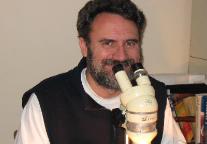
Ted Pike
B.S, M.S. Entomology, P.H.D. Amber
tmpike@shaw.ca
Biography
Ted has played a very key role in the study of Burmite , examining amber specimen photos to make sure that
scientifically important pieces are retained for study. He has also been instrumental in discovering one of the first two
Burmite flowers. His importance and tireless efforts to this team can not be overstated.
B.S, M.S. Entomology, P.H.D. Amber
tmpike@shaw.ca
Biography
Ted has played a very key role in the study of Burmite , examining amber specimen photos to make sure that
scientifically important pieces are retained for study. He has also been instrumental in discovering one of the first two
Burmite flowers. His importance and tireless efforts to this team can not be overstated.
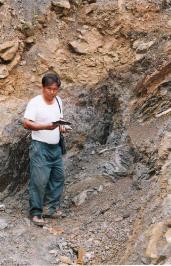
Ko ko,
B.S. Geology, Yangon University, Burma
Contact Ko Ko through Jim Davis at jdavis@taiga-ltd.com
Biography
Ko Ko is a trained Geologist who travels through Burma locating sites for the treasured Burmite amber with its fantastic
insect inclusions. He also was involved in writing the divinite paper which place the age of Burmite at 100 to 110 million
years old.
B.S. Geology, Yangon University, Burma
Contact Ko Ko through Jim Davis at jdavis@taiga-ltd.com
Biography
Ko Ko is a trained Geologist who travels through Burma locating sites for the treasured Burmite amber with its fantastic
insect inclusions. He also was involved in writing the divinite paper which place the age of Burmite at 100 to 110 million
years old.
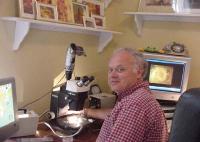
Ron Buckley
B.S Business Administration Penn State University , R. N. Nursing
ronbuckley@fuse.net
Biography
Ron has a passion for amber and the mysteries it holds since 1972. He has coupled this interest with a real passion for
photography , especially microphotography. Ron has photographed over three thousand Burmite specimens. He will
take over a hundred shots of each specimen until he gets the picture quality he wants. He put together a collection of
one hundred and fifty scientifically insect and botanical specimens. He has been involved with many scientific papers
with Dr. George Poinar. Ron has experienced a few medical problems and this collection is now in the possession of
Deniz Erin of Istanbul Turkey . Denis Erin will make these specimens available for scientific study.
B.S Business Administration Penn State University , R. N. Nursing
ronbuckley@fuse.net
Biography
Ron has a passion for amber and the mysteries it holds since 1972. He has coupled this interest with a real passion for
photography , especially microphotography. Ron has photographed over three thousand Burmite specimens. He will
take over a hundred shots of each specimen until he gets the picture quality he wants. He put together a collection of
one hundred and fifty scientifically insect and botanical specimens. He has been involved with many scientific papers
with Dr. George Poinar. Ron has experienced a few medical problems and this collection is now in the possession of
Deniz Erin of Istanbul Turkey . Denis Erin will make these specimens available for scientific study.